
You have a difficult week. Work is full on, it feels like somebody needs something from you every eleven minutes, sleep has become more distant memory—and suddenly your back, jaw, head or even your entire body decide to join in and make life even harder.
It is common for persistent pain to become more intense during periods of stress. Unfortunately, people are often reluctant to mention this because they fear hearing, “So it’s in your head. It’s just anxiety etc.”
Now you hide it, pretend your fine, or feel guilty because you don’t want to be judged on top of all your symptoms as well.
Let’s make one thing clear right away – Stress influencing pain does not make pain imaginary at all. Stress very much alters physical tensions, states, pain perception and much more. Let’s have a look at a simplified version of what goes on when stress and symptoms flares coincide.
Pain and stress share some of the same systems
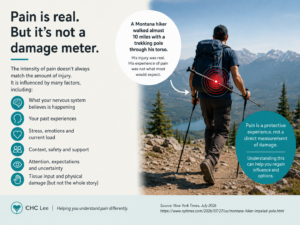
Pain is not only a damage signal travelling from a body part to the brain. It is an experience produced by the nervous system using information from the tissues, the immune system, past experience, attention, expectations and the current situation. Have you ever bumped your elbow, had excruciating pain just to find out a few minutes later, there isn’t even a bruise? That’s because your brain received an unexpected overload of information from the elbow, measured the incoming as information as potentially dangerous and urgent and started to shout, “OMG, pay attention!” You calm down, check over your elbow and the pain starts to subside.
Physiological Stress also involves the system reading potential “danger” and urgency. We specifically say physiological stress, because your nervous system setting can be “stress”, even when life itself objectively might not “appear” stressful from the outside.
Instead of a physical bump (or otherwise) initiating the “shouting”, multiple systems are involved in measuring and assessing the situation: the autonomic nervous system, hormonal responses, immune activity, attention, sensitivity regulation, sleep and muscle activity.
Pain and stress meet in rather a lot of places. Research describes a reciprocal relationship: pain can be stressful, and repeated or prolonged stress can alter pain regulation. But the effect is not identical in everyone.
Stress can increase or temporarily suppress pain
During an immediate emergency, stress can temporarily reduce pain. The body may prioritise escape, protection or getting through the situation. Some people therefore cope surprisingly well during a crisis and experience the flare afterwards, once the immediate demand has passed.
At other times, stress increases sensitivity. Attention narrows towards threat, sleep deteriorates, muscles brace, ordinary sensations feel more significant and the nervous system may become quicker to protect.
This helps explain why the relationship is rarely as neat as:
Stressful event on Tuesday = immediate pain on Tuesday.
The stressor does not have to be dramatic
Stress can include obvious events such as bereavement, conflict, illness or financial pressure. It can also include:
- repeatedly overriding your own limits;
- feeling responsible for everybody;
- uncertainty about what your symptoms mean;
- being disbelieved;
- loneliness or lack of support;
- suppressing anger, fear or grief because there is no safe space for them or we have not learnt how to process them.
- physical overload, under-recovery or poor sleep.
This does not mean one upsetting emotion “caused” your condition. Persistent pain usually has several interacting influences and or prolonged exposure to unresolved stressors. Important: physical pathology must not be waved away simply because life is stressful. If you suddenly experience new symptoms you have never had, a doctor’s visit should be your obvious first choice. Medical safety must come first, even through stress may still play a % part of your symptoms and can still be addressed alongside medically necessary interventions.
Why can symptoms appear after the stress has passed?
People sometimes say, “But I was fine while it was happening.” That does not rule out a connection.
During a demanding period, attention and stress-related analgesia may temporarily reduce awareness of pain. You may also move differently, clench muscles, eat irregularly and sleep less without noticing the cumulative cost. Symptoms can become more noticeable when the system finally has enough space to register them.
That is not your body being dramatic. It may simply be a delayed bill.
Is this where Pain Reprocessing Therapy fits / Integrative Osteopathy fits?
Pain Reprocessing Therapy (offered at CHC as part of Integrative Osteopathy) is intended for selected forms of primary chronic pain, where symptoms are not adequately explained by ongoing tissue injury or disease. It aims to help the person interpret safe sensations as less threatening and respond with less fear.
In one randomised clinical trial involving 151 adults with primary chronic back pain of low-to-moderate severity, PRT produced substantially better outcomes than open-label placebo or usual care. The result is promising, but it does not establish PRT as a treatment for every pain condition, and participants were carefully assessed before entering the trial.
During Integrative Osteopathy sessions we may also explore learned protective responses, stress, emotional conflict, self-pressure and patterns of avoidance. Some of its components overlap with researched approaches including pain education, emotional awareness and expression therapy, and PRT. Integrated Osteopathy integrates techniques from already researched therapies and is not a method or approach. It utilizes proven strategies from different therapies.
Where Integrative Osteopathy may help
Integrative Osteopathy does not mean deciding in advance that every symptom is caused by stress. It begins with assessment.
Depending on the person, care may involve:
- examining whether a new physical problem requires treatment or referral;
- using hands-on treatment where appropriate to support comfort and movement;
- rebuilding confidence in movement and physical capacity;
- explaining how stress, sleep and symptom interpretation may influence pain;
- identifying bracing, guarding and overload;
- combining physical rehabilitation with SIRPA-informed or PRT-informed work when clinically suitable.
The aim is not to choose between “physical” and “emotional”. Humans are and will be forever more both.
What can you do during a stress-related flare?
First, do not automatically assume that a flare means new damage. Equally, do not automatically assume it is “just stress”. Notice what has changed and seek assessment if the symptoms are new, progressive or concerning.
It may help to:
- reduce unnecessary demands for a short period without abandoning all activity;
- return to familiar, comfortable movement;
- protect sleep where possible;
- notice catastrophic interpretations without arguing aggressively with yourself;
- name what is actually difficult rather than forcing yourself to “calm down”;
- seek medical or therapeutic support when needed.
You do not have to become perfectly relaxed to recover. Fortunately, pain recovery does not require moving to a mountain and developing the temperament of a Chinese Monk.
Frequently asked questions
Does stress cause inflammation and therefore pain?
Stress can influence immune and inflammatory processes, but the relationship is complex. It is inaccurate to assume that every stress-related flare is caused by inflammation or cortisol.
If distraction reduces my pain, does that mean it is not real?
No. Attention influences every pain experience, including pain from clear physical injury. A change with distraction is information about pain modulation, not evidence of your pain being imagined.
Should I ignore pain if I know I am stressed?
No. New, unexplained or changing symptoms deserve appropriate assessment. Understanding stress as one possible influence is not permission to ignore your body or safety concerns. Safety first. Always!
A more useful question
Instead of asking, “Is this physical or stress?”, it may be more useful to ask:
| What combination of tissue health, nervous-system sensitivity, physical capacity, sleep, stress and current circumstances could be influencing this experience? |
That question leaves room for proper assessment—and considerably more room for change.
Further reading:
- Howard Schubinger: Unlearn Your Pain, 2026
- Timmers I, et al. The interaction between stress and chronic pain through the lens of threat learning. Neuroscience & Biobehavioral Reviews, 2019. https://pmc.ncbi.nlm.nih.gov/articles/PMC6914269/
- Aboushaar N, et al. The mutually reinforcing dynamics between pain and stress. 2024. https://pmc.ncbi.nlm.nih.gov/articles/PMC11609167/
- Ashar YK, et al. Effect of Pain Reprocessing Therapy vs Placebo and Usual Care for Patients With Chronic Back Pain. JAMA Psychiatry, 2022. https://jamanetwork.com/journals/jamapsychiatry/fullarticle/2784694