

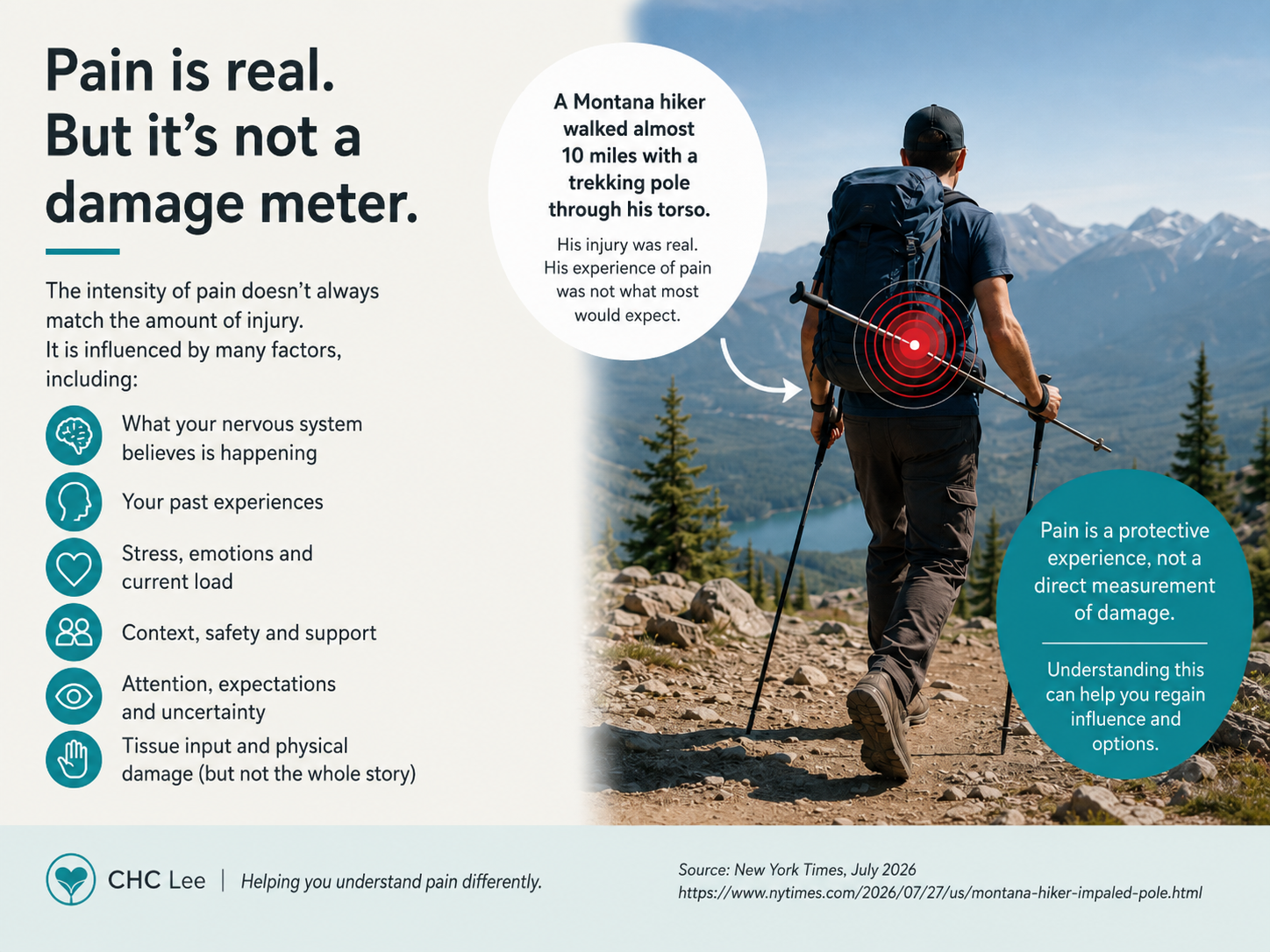
When pain is severe, it is entirely understandable to worry that something in your body must be badly damaged.
When scans or tests do not reveal a clear cause, you may feel confused—or even wonder whether anyone believes you.
And when pain changes dramatically from one day to another, it can feel as though your body has become unpredictable and impossible to trust.
These experiences may appear very different, but they are connected by one important fact:
Pain is real, but it is not a direct measurement of tissue damage.
A recent and extraordinary hiking accident demonstrates this far more clearly than any textbook definition could.
The hiker who walked ten miles with a pole through his torso
In July 2026, David Cifaldi was climbing Granite Peak in Montana with two friends when he slipped and fell onto one of his trekking poles.
The pole entered below his left arm and emerged through his lower back. It had caused a genuine and potentially serious injury, although it had narrowly missed his major organs.
Cifaldi, who had worked as an emergency-room nurse, assessed his breathing and bleeding and concluded that the injury did not appear immediately life-threatening. With help from his friends, he then walked approximately ten miles over difficult mountain terrain before reaching medical care. The journey reportedly took around six and a half hours, after which the pole was removed in hospital.
Read the original New York Times report
You might read this story and think:
“He must have an extraordinary pain threshold. I could never do that.”
But treating this purely as a story about toughness misses the most useful part.
His injury was real. It required surgery. Yet his experience and behaviour were not determined solely by the amount of physical damage present.
That same principle applies to your nervous system too.
Why doesn’t pain always match damage?
Pain is commonly described as though signals travel from an injured body part to the brain, where they are displayed like a reading on a dashboard.
But the nervous system is not simply reporting damage.
It is interpreting information and producing a response intended to protect you.
The International Association for the Study of Pain defines pain as both a sensory and emotional experience associated with—or resembling that associated with—actual or potential tissue damage. It also emphasises that pain is a personal experience influenced by biological, psychological and social factors.
Information from the tissues matters. Sometimes it matters urgently.
But the eventual experience of pain can also be influenced by:
- what your nervous system believes is happening;
- how threatening or uncertain the situation feels;
- previous experiences;
- attention and expectation;
- sleep, fatigue and physical capacity;
- stress and emotional overload;
- whether continuing to move or stopping appears most protective.
This is why a significant injury can occasionally produce less pain than expected.
It is also why intense or persistent pain can continue when an injury has healed, medical investigations are reassuring or the physical findings do not fully explain the severity of someone’s experience.
Neither situation means that the person is imagining anything.
Why does this matter to you?
Because what you believe pain means will influence what you do next.
If you believe that little pain must mean little damage, you may dismiss a new injury or illness that needs assessment.
If you believe severe pain must mean continuing damage, you may become frightened of movement, brace your body constantly or avoid activities that are actually safe.
You may keep searching for a single damaged structure because nobody has explained that pain can continue for other reasons.
You may also feel failed by your body—or dismissed by healthcare professionals—when test results do not match the intensity of what you feel.
A more accurate understanding does not tell you to ignore pain.
It helps you ask better questions:
- Is there a new injury, illness or physical problem that needs investigation?
- Is healing still taking place?
- Has my body become more protective than the current situation requires?
- What makes my symptoms better, worse or more threatening?
- What would help me rebuild capacity and confidence safely?
New pain and persistent pain may need different approaches
A new, changing or unexplained symptom may require physical assessment, medical investigation, treatment or rehabilitation.
The story of the Montana hiker is an important reminder that the absence of extreme pain does not rule out injury.
Persistent or recurring pain may require a broader approach.
Once symptoms have continued for months, repeatedly returned or become disproportionate to the current condition of the tissues, it may be helpful to consider not only the painful area but also the wider protective system.
That does not mean abandoning physical care.
It means examining the whole experience rather than assuming every symptom has one purely structural explanation.
Kathi’s approach to persistent pain at CHC Lee
Pain education and integrative pain recovery are a particular focus of Kathi Meier’s work within CHC Lee. This should not be confused with a clinic-wide method used by every practitioner.
Kathi is a registered osteopath and SIRPA practitioner who has undertaken additional training and ongoing study in persistent pain, nervous-system protection and the relationship between physical symptoms, emotional strain and overload (and yes – all evidence based)
Depending on the individual and what is clinically appropriate, her work may include:
- osteopathic assessment and treatment;
- explaining pain in a way that relates to your own symptoms;
- exploring movement, physical capacity and fear of movement;
- recognising patterns of bracing, guarding and overload;
- developing greater emotional awareness and literacy;
- helping you identify what safety feels like physically, rather than merely telling you to relax;
- gradually creating new experiences through which protective responses can change.
This is not about “resetting” or fixing a defective nervous system.
It is about helping your nervous system receive clearer information and learn through repeated experience.
Why offer this within a multidisciplinary clinic?
Not everyone in pain needs the same practitioner.
One person may need a purely osteopathic or physiotherapy assessment.
Another may require podiatry, hand therapy, medical investigation or rehabilitation.
Someone living with persistent symptoms may benefit from combining physical care with pain education, counselling or another form of support.
CHC Lee’s multidisciplinary setting makes it possible to consider different starting points without pretending that one profession or treatment can explain every pain experience.
Kathi’s specialist pain work is one part of that wider centre.
You are not helpless—but you are not to blame
Learning that pain is influenced by the nervous system can initially feel uncomfortable.
Some people hear it as:
“You are causing this.”
“You should be able to control it.”
“You only need to calm down.”
That is not what it means.
Pain is not consciously chosen. Protective responses can develop through injury, illness, stress, trauma, repeated overload and many other experiences.
You are not to blame for those responses.
But neither are you necessarily powerless within them.
You may not be able to switch pain off. You may, however, be able to change some of the information, experiences and conditions influencing how much protection your system believes you need.
That is a very different—and much more hopeful—message.
Frequently asked questions
Does severe pain always mean serious damage?
No. Severe pain should be taken seriously, but its intensity does not by itself reveal the amount of tissue damage present. Assessment may be needed to understand what is contributing to it.
Can someone have a serious injury without much pain?
Yes. Acute stress, context, attention and the structures affected can all influence pain. A lack of severe pain should never be used to rule out a significant injury.
Does persistent pain mean the problem is psychological?
No. Pain is neither “purely physical” nor “purely psychological”. It is a real experience involving the whole person and nervous system.
Can the nervous system learn to become less protective?
Protective responses are capable of changing. This is not usually achieved by positive thinking or simply trying to relax. Learning may involve understanding symptoms, restoring movement and capacity, addressing overload and repeatedly experiencing greater safety.
When should I seek medical help?
Seek appropriate medical advice when symptoms are new, sudden, changing, following significant trauma or otherwise concerning. Call NHS 111 when you need urgent advice but it is not a life-threatening emergency. Call 999 for a medical emergency.
Finding the right starting point
If you are unsure which CHC Lee service is appropriate, visit our What Should I Book? guide or contact reception.
If you are living with persistent or recurring pain and would like to explore Kathi’s integrative approach, or visit Kathi Meier’s practitioner profile.
Understanding pain does not make it less real.
It gives us more accurate—and potentially more useful—ways of responding to it.
Further reading
International Association for the Study of Pain — Definition of pain – updated for the FIRST TIME SINCE 1979